Pekka Kuusisto: Legends & Luminaries. Australian Chamber Orchestra. City Recital Hall. October 3
Four and a half stars
Nico Muhly named the three movements of his Violin Concerto, Shrink (commissioned by the ACO and Melbourne Recital Centre and first performed in 2019), according to the technical musical elements they focus on, Ninths, Sixths, and Turns. This recalls the way Debussy named his Piano Études, where, the technical nomenclature almost appears to deliberately avoid the evocative and poetic titles Debussy had used earlier in his career. Yet technical terms don’t need to seem clinical. Stravinsky praised Beethoven’s Grosse Fuge, saying: “It is pure interval music, this fugue, and I love it beyond any other.” In the case of Muhly’s concerto, the focus on small musical cells sits alongside an impressive capacity to sustain musical thought and build up tension over a long span.

The first movement was spiky, its crackling energy firing off motives and deliberately dissipating its energy. The second movement was made of smoother lines (its textures occasionally reminiscent of Debussy’s Étude pour les Sixtes) building to quasi-Baroque cross-string figurations of imposing force before attenuating the dynamism to a moment of stillness which was the static fulcrum on which the work turned. The last movement returned to driven momentum, energised by short rhythmic motives, offset tellingly by dragged sustained ideas from violin soloist, Pekka Kuusisto, and orchestral cellos and double bass. Overall, the work seemed to scatter its energy wildly in the first movement, find its centre in the slow movement, from which it rose with determined focus and mounting insistent in the finale. Kuusisto’s sinewy clarity, impeccable precision and limpid buoyancy in rhythm was ideal in this music, and he and the ACO projected the work’s complex cross metres and rhythms with fine intuitive accent and in a deeply embodied way.
Composer Nico Muhly: Photo credit, Heidi Solander

West Coast Sky Eternal (receiving an Australian premier) by American composer Ellen Reid began with a phrase from Kuusisto like a deep intake of breath and the music quickly built to big undulating chords. There were a series of such episode unfolding in similar ways, sometimes vertiginously, before the music slowed and slid to the low register. A pizzicato section led to light jazz-like rhythms which drifted apart to different metres and a fragmented, aleatoric and pointillist fabric. After a more brooding passage with sustained notes, the work closed with folk-like melodies, airy harmonics and wispy sounds against noise chattering into the wind. Reid describes it as starting with a wide-angle panorama, flecked with the “shards” of our choppy daily lives. In some respects it moved in the opposite direction to Muhly’s, beginning with a landscape as seen from above before being drawn into gritty minutiae.
Composer Ellen Reid: Photo credit, Erin Baiano
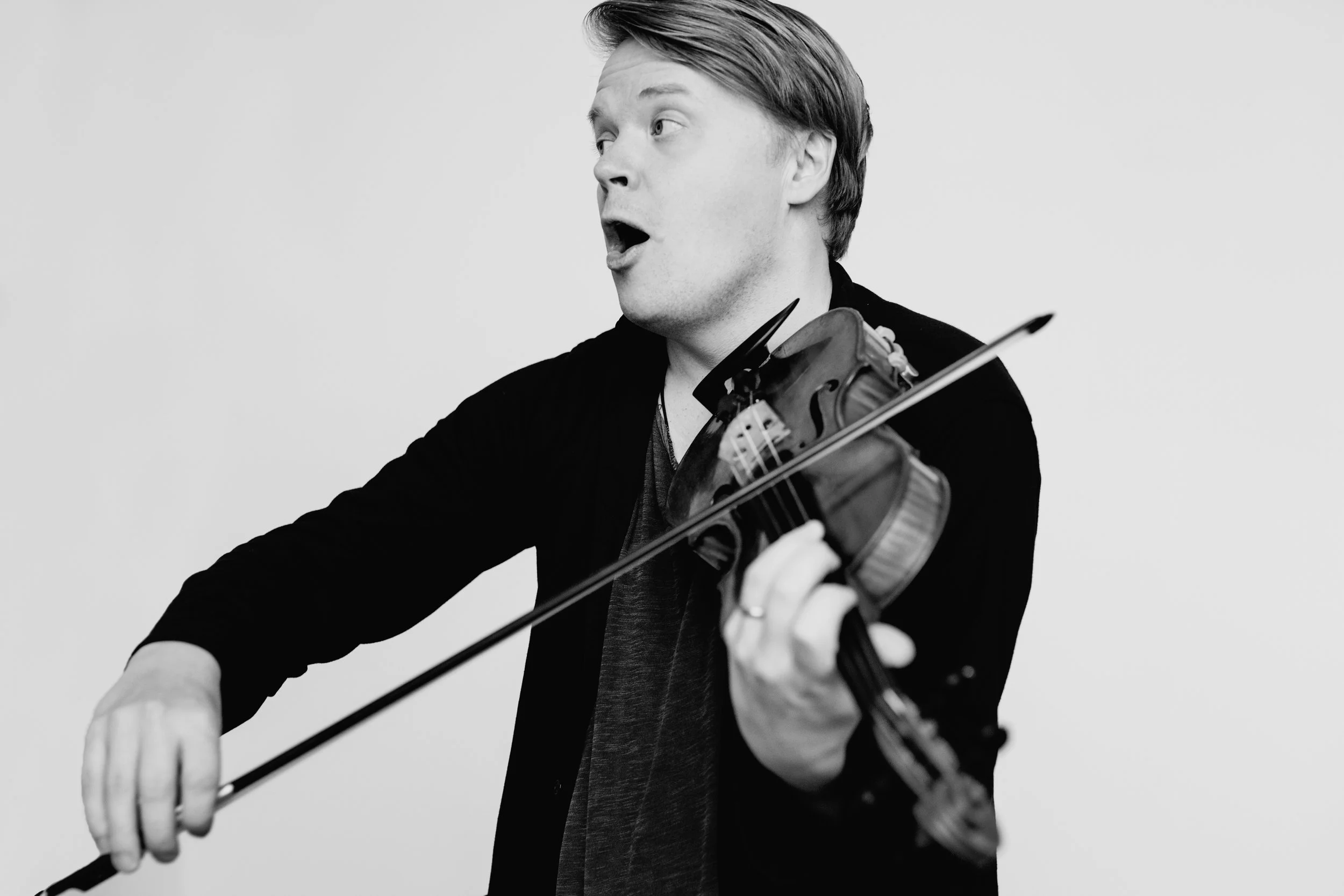
Guest Director and solo violinist, Pekka Kuusisto.
Photo credit Bard Gundersen
Kuusisto, as the ACO’s Guest Director for this tour, framed these contrasting contemporary works, with music by Mozart and Mendelssohn (the link being that he sees Muhly as having a similar “lightning-speed brain” as the earlier iconic prodigies). The opening selection of arrangements for string orchestra from Mozart’s The Magic Flute moved (after the Overture) from Bei Männern to the Queen of the Night’s aria, thus inverting the direction of the original opera which moves from turmoil to wisdom and love. The outer movements of Mendelssohn’s String Quintet No. 2 in B-flat major, Opus 87 (arranged for string chamber orchestra) opened out with animation and elan, capturing something of the child-like spirit which inhabits The Magic Flute (and also Kuusisto’s own performing persona). The second movement flipped between minor and major keys phrase by phrase in a mood of wistful, occasionally melancholy charm. For the third movement, also in a minor key, the ACO drew a sound of deep expressive warmth from the inner voices, and one of vivid radiance and resonance in the tremolo patterns which accompany the theme on violin when it returns at the close. This was a generous program but Kuusisto added folk-like improvisations, the first appearing as interlude after the close of Reid’s work while the stage was rearranged (and picking up the spirit of Reid’s close), and the second as an energetic encore, charming in its rhythmic irregularity.